
Dear Diary,
Will my curly hair ever be long?
Dazed, Harpers BAZAAR, ELLE, Marie Claire and other major fashion and beauty editors just declared it. The bob is dead, long hair is back, and if you believe the street style photos, everyone from the tube platform to the front row has spent 2026 growing it out. We read the piece. We have thoughts.
Because here's the thing about ‘long hair is back’ as a headline, it was never gone for some of us. It just wasn't being photographed.

What does ‘long’ actually mean?
The Dazed piece traces long hair's history as a symbol. Femininity, purity, wealth, virility, counterculture, depending on the decade and the head it's sitting on. And this year, apparently, it symbolises something like anti-performance. Healthy, undone, natural-looking hair as a rejection of the styled, filtered, hyper-groomed Instagram era. Stylists in the piece talk about clients wanting ‘minimal off,’ about hair that moves, hair that isn't trying too hard.
Which is a nice idea. Genuinely. But notice what's doing the symbolic work here: length. Not texture, not health, not how the hair actually behaves day to day. Length. And length, on its own, is not a neutral measurement. It's a straight hair measurement wearing a neutral costume. When we talk about curly hair length, we're talking about something the straight hair yardstick was never designed to measure.

Here's the thing about length: it isn't measured the same way on every texture.
As a brand that lives and breathes texture, what does ‘long’ actually mean once you take straight hair out of the equation? On straight or loosely wavy hair, length and gravity are basically in agreement. The hair grows, the weight pulls it down, and inches translate fairly directly into visible reach down the back. But curl pattern changes that relationship entirely. The tighter the curl, the more that same growth gets absorbed into shrinkage before it ever shows up as length down the body. A head of 3C or 4A curls with 20 inches of actual hair growth might sit at the shoulders, not approaching the waist, not because the hair is shorter, but because the curl is doing exactly what curls do: coiling that growth upward and outward instead of letting it hang.
There's real science behind why this happens. It's one of the most searched questions in the curly hair community: does curly hair actually grow as fast? Or how do you make curly hair grow? It does. It's just measuring it wrong that makes it seem otherwise. Gravity pulls on every strand with the same force regardless of texture, what changes is how much a curl pattern resists that pull. Looser curls and waves are more easily weighed down by their own length as hair grows, which is why they tend to relax and elongate over time. Tighter curls are naturally springier and more resistant to that same gravitational pull, holding their shape and their shrinkage even at significant lengths. Hair thickness and density play a role too: thicker, denser hair resists the pull of gravity more than fine, sparse strands, whatever the curl pattern.
In other words, a 3C or 4A curl doesn't become long the way straight hair does. It becomes voluminous first. The length is real. It's just travelling in a different direction.

And what about grooming?
If we're calling long, straight, undone hair ‘anti-performance’ — low-effort, natural, hair that's simply been left alone to grow — we have to be honest about what 'undone' curly hair actually requires to look that effortless.
A proper curly wash day isn't a shower and a leave-in. It's pre-poo, detangling, cleansing, deep conditioning, product application section by section, diffusing or air-drying for hours, and then whatever finishing step gets you an actual defined result rather than a frizzy one. Ask anyone who's done it properly and the honest answer is that a full wash day can take upwards of 8 hours. That's not a beauty routine. That's a full working day, and it happens every single week for a lot of us. We’d say that is long hair because that maintenance? SO long to do!
So, is long hair becoming performative?
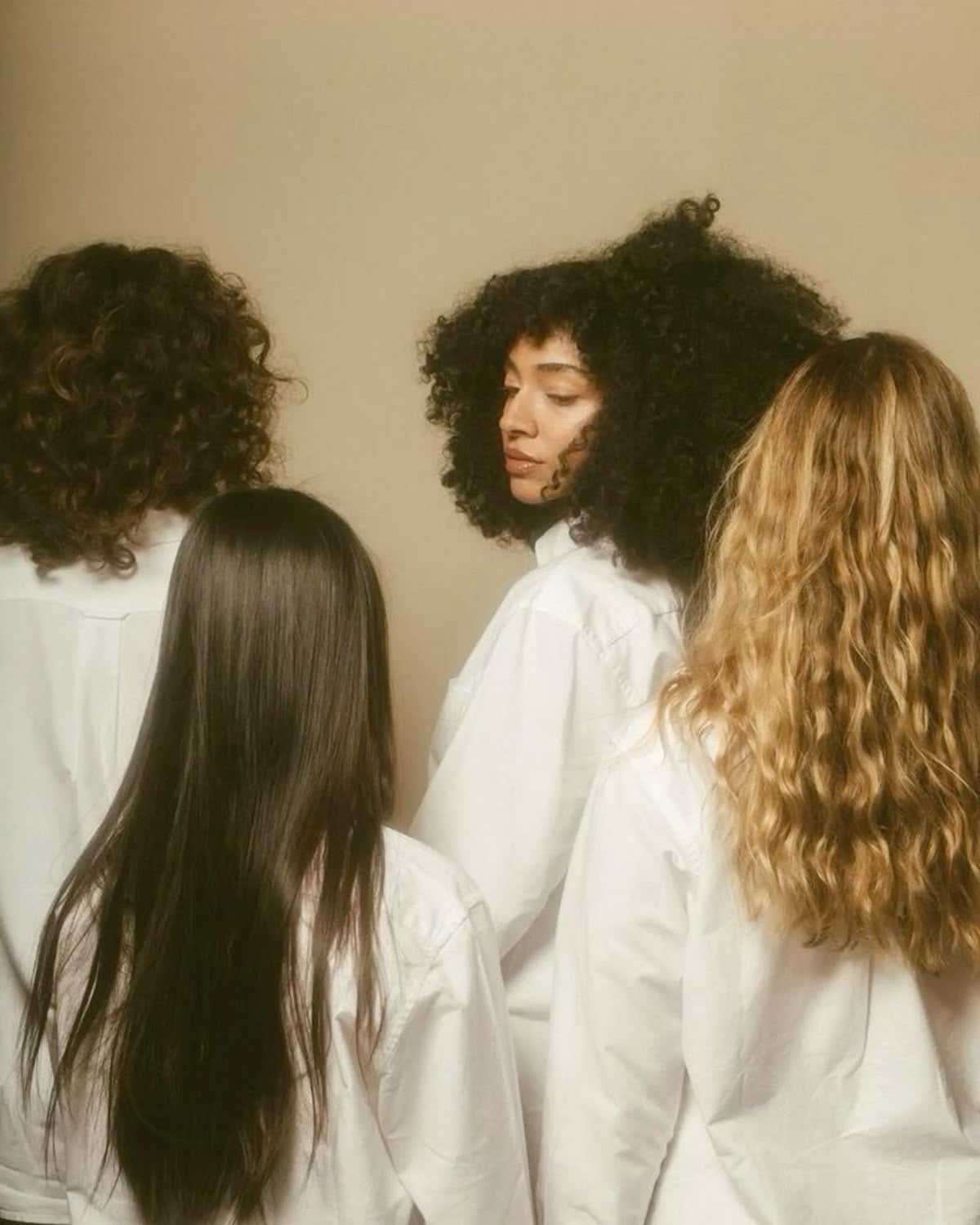
Maybe the more interesting question isn't whether long hair is performative. It's whether the current definition of ‘long’ was ever built with every texture in mind. If length is only being measured by how far hair hangs down the back, then textures that translate growth into volume instead of drop are being left out of the trend entirely. Not because the hair isn't long, but because ‘long’ was never really the right word for what curls do with extra growth.
So, is long hair becoming performative? Or is the question actually simpler than that: is long hair back, or is more hair back? We think more. And we think that distinction changes everything.

We'd argue a wash and go with real volume, a fully defined twist out, a half wig with the density to hold a shape and stand away from the head are just as much 'long hair' as anything hanging past the waist. The inches are there. They're just showing up as fullness instead of falling. So the real question is: do you want a fuller look, or do you want a lengthier look? Because they're not the same thing and for extensions especially, that distinction matters more than most people realise.
For curly hair extensions, the same rule applies. All our bundles weigh 100g. But longer hair strands weigh more than shorter ones, which means the longer the bundle, the less ‘full’ the hair actually is, the same 100g is just spread over a greater length. So if fullness is what you're after (that big, voluminous, effortlessly healthy result) adding another bundle at your current length will give you more of what you're looking for than going up in inches will. More hair, not longer hair. And the generous secret? More hair often reads as longer anyway, because volume has a way of creating the illusion of length that a less dense longer bundle simply can't.
Or maybe we're just measuring it wrong.
Here's a more opinionated take: what if the tighter the curl, the longer the hair actually is, we just haven't been counting it that way?
Think about it in reverse. If a straight strand and a coiled strand both grow from the scalp at roughly the same rate, and the coiled strand is coiling that growth into shrinkage, tension, and volume instead of letting it fall, then inch for inch, the curly strand isn't ‘losing’ length. It's storing it. Stretch that same 4A or 4C curl out fully and it's often far closer to the length of the "long hair" being celebrated than it ever looked sitting on the head. The length was never missing. It was just coiled up, doing something other than hanging.
Which means the real story here isn't ‘curly hair is shorter.’ It's that we've inherited a definition of ‘long’ built entirely around hair that hangs and it's time that definition got a redefinition of its own.
This isn't even a new idea, if you look back far enough. In ancient Egypt, curls were a mark of status and beauty, not despite their volume, but because of it, so much so that elaborate wigs were woven from tightly coiled hair specifically to achieve that fullness. Renaissance nobility spent hours crafting curl into their hair on purpose, curl was the aspiration, not the obstacle. Long before ‘long and flowing’ became shorthand for beautiful hair, ‘full and coiled’ already meant exactly that, in rooms that mattered.
So maybe we're not asking the industry to make room for a different kind of long hair. Maybe we're asking it to remember one it already knew.

If volume is the goal, here's how you actually get there:
-
Trim with intention, not fear. Light, regular trims remove the split ends quietly weighing your curl pattern down, letting the healthy hair spring back up rather than hang.
-
Don't overwash, don't underhydrate. Curl definition needs moisture to hold its shape, but product buildup does the opposite, pulling the pattern down instead of letting it lift.
-
Choose density where it counts. For half wigs and extensions, density does as much work as length. More hair reads as longer before longer hair reads as fuller — and for curl patterns, that's the more accurate flex. We don't want hair that hangs. We want hair that moves.
-
Let go of the straight hair chart. Measuring your curls against a length that was only ever going to hang on straight hair is a losing game. Measure against your own pattern instead: where does your hair sit at its healthiest, fullest, and is that the goal you're actually working toward? Real hair growth for curly textures shows up in volume before it shows up in inches
So no, undone, natural, healthy looking hair isn't the opposite of effort. For a lot of textures, it's the result of some of the most consistent, time intensive effort in the entire beauty industry. And we understand it that way!

Long hair isn't performative. But maybe the definition of ‘long’ has been, for a while now quietly built around one texture's relationship with gravity, and calling it universal.
Ours has just been growing in a different direction the whole time.
With love and curls,
xoxo
The Curly Hair Diaries